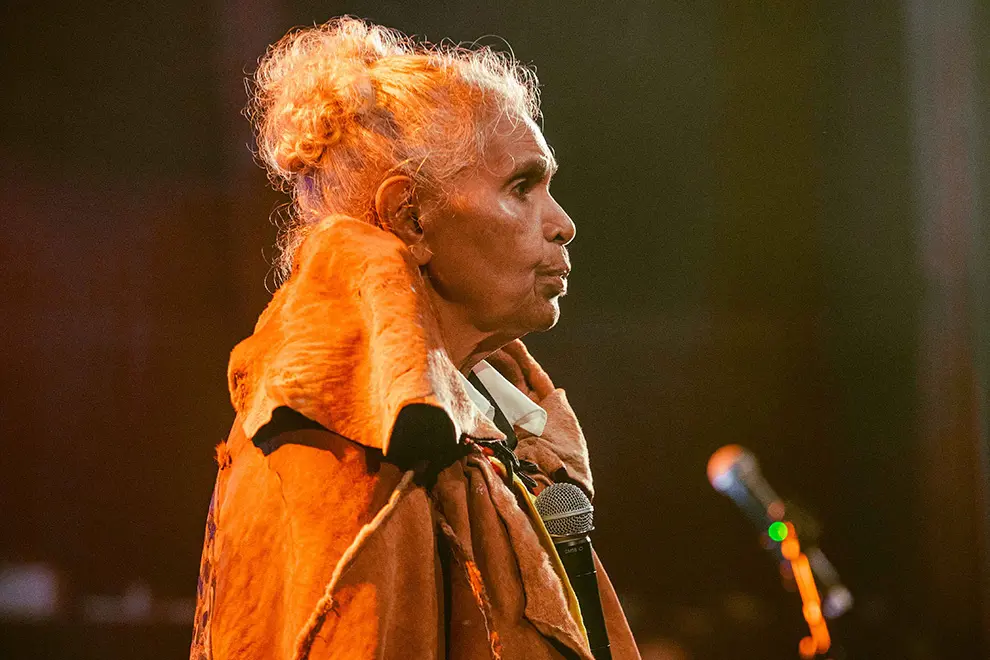
Aboriginal and Torres Strait Readers are advised that this story contains the image of a person who has died with family permission.
Maroochy Barambah, a traditional Songwoman and Turrbal Elder, has passed away at the age of 70, it has been revealed.
News of Maroochy’s death was announced on Wednesday, January 28th by Turrbal Dippil, who confirmed that she passed away earlier in the day “following a courageous battle with cancer.”
“Maroochy was a revered Turrbal Elder, traditional Songwoman and Law-woman, trailblazer, and matriarch whose life and work profoundly shaped not only our Meeanjin (Brisbane) community, but also the broader Australian community,” the statement read.
“Maroochy’s passing is an immense loss. She was a powerful advocate for Aboriginal rights and cultural recognition, and a pioneering artist whose voice carried the stories, strength, and spirit of her people across the nation.
“As Australia’s first Aboriginal opera singer, Maroochy broke barriers with grace and determination, creating space for future generations of First Nations artists to stand proudly in their culture and truth. Her music, activism, and leadership helped elevate Indigenous voices at a time when they were too often silenced, and her influence continues to be felt across the arts, education, and reconciliation spaces.”
Born in Cherbourg, Queensland on February 12th, 1955 of Turrbal and Gubbi Gubbi descent, Maroochy’s early life was spent in Australia's north-east until she was sent to live with a white foster family in Melbourne. it was during this time she met with actor Uncle Zac Martin who encouraged her to "record the stories and legends of his people."
Her interest in the arts gave way to a decision to attend the Melba Conservatorium Of Music in te '70s, graduating in 1979, and entering the wider music world with appearances with the group Quokka, alongside her own jazz outfit.
She rose to wider fame with an appearance in the production of Black River, with its focus on Indigenous deaths in custody seeing her become the first Indigenous opera singer to perform on stage in Australia.
Maroochy’s profile rose in the ‘90s, with singles such as 1994's Mongungi and 1996's Aborigine giving way to the Once Upon A Dreamtime record the following year, and appearances at the likes of the 1993 AFL Grand Final and myriad other performances seeing her become a revered figure of the Australian music world.
“Beyond her remarkable public achievements, Maroochy was a cultural custodian who carried deep knowledge, generosity, and responsibility for Country and community,” Turrbal Dippil’s statement continued. “She lived her values with integrity, ensuring that culture was not only preserved, but shared in ways that fostered understanding, respect, and unity.
“Maroochy leaves behind her daughters, Baringa and Kulkarawa, and her beloved grandson, Dalapai. She also leaves behind an enduring legacy, one that will continue to guide, inspire, and strengthen all those committed to the ongoing journey of reconciliation.
“We extend our deepest gratitude to the many people who have walked alongside Maroochy, supported her work, and been touched by her life” the statement concluded.
“Maroochy’s spirit, voice, and legacy will forever remain woven into the fabric of our nation.”