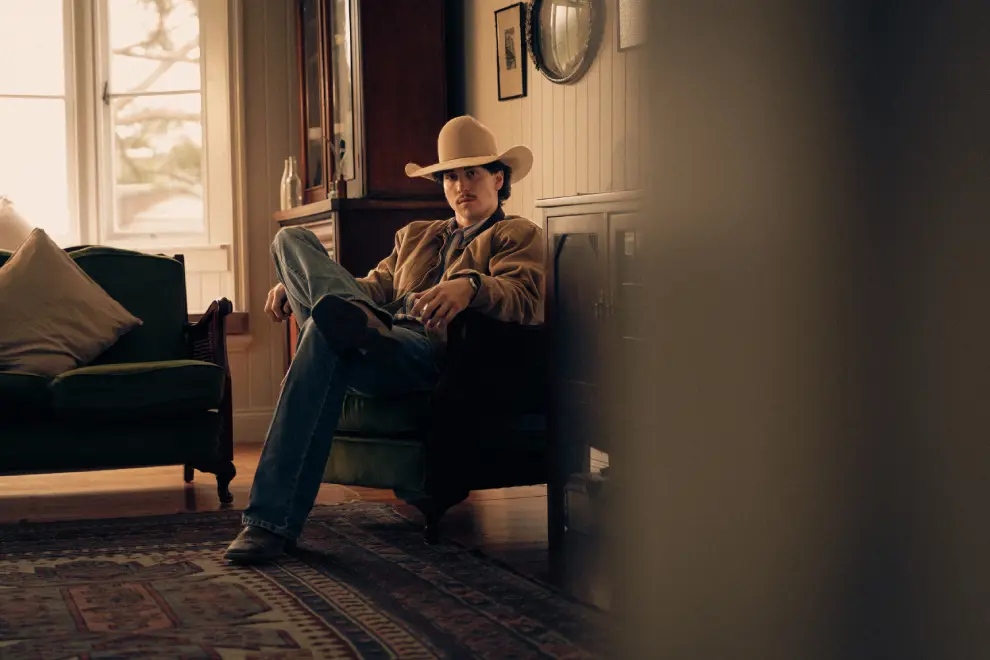
 Mack Geiger Profile
Mack Geiger had one year to go with his paramedicine studies, and he didn’t see music as a realistic option at first. But uploading String By online, which went on to enter the Billboard Hot 100, changed his trajectory, and he walked away from his degree for the country music scene.
Countrytown asks him if studying a field with the fragility of life constantly on display gave him a now-or-never attitude towards his music. “I think it definitely would have,” he says. “It showed me that tomorrow is uncertain.”
Spending time in bars, listening to lots of conversations from old folks, Geiger heard his fair share of what-ifs and the “coulda, woulda, shoulda… I guess if I learned anything from that is that I don’t want to be that guy.”
One thing is certain, however: after a listen of the debut album, Dying In This House, which is released today, it’s obvious that Australia has found its newest country star in 21-year-old Mack Geiger from Mount Larcom in Queensland.
It was a two-year span for Geiger from the time he won a music contest at the Ekka to the moment he stepped on stage at Nashville’s Grand Ole Opry, and we wonder whether it was a bit of a slog between the two points or if it happened seamlessly.
“Definitely a lot of hard work behind the scenes,” Geiger answers, recalling the pub crowds who were “just there to drink and have fun” and the battle to sneak originals into his set list. “People didn’t really want to hear them. They just wanted to hear the sing-alongs like Chicken Fried and Wagon Wheel.”
The album kicks off in a light-hearted way with His & Hers, a song penned by Ohio musician Wyatt McCubbin. Geiger describes it as timeless and fun, and says he fell in love with it upon first hearing. Stylistically, one can hear a blend between Aussie and American, and we question if that was a conscious choice. He answers, “I’m just sort of singing it the way I want to sing it.”
By track four, the album’s title track sets a “serious tone,” and Geiger believes it’s one of the strongest on the album. We ask about the heaviness of the album title, and he says that the whole album had him diving into his strengths, which he clarifies are “more emotional songs and a lot of heartbreak.”
Calling these sad songs his “bread and butter,” he adds, “I don't know why I'm drawn towards them so much, but I really enjoy a good sad song.” He supposes it has something to do with listening to a lot of traditional country music growing up: “You know, you lose your dog and your missus and your house and your boat and all that.”
The album’s announcement had Geiger stating it “channels a broken man’s walk through loneliness, heartache, denial, but also glimmers of hope.” How much of the broken man is him? While he draws inspiration from past experiences, he says a lot of it is “putting myself in other people’s shoes.”
Geiger then turns to gratitude, saying he’s had a “pretty good life” and that he hasn’t been through “that much hardship compared to some people.” He explains that his storytelling comes from channelling dark times and negative emotions, and that understanding sadness and picking it apart gives him something to offer.
Geiger is set to appear at Stagecoach in California next April, alongside legends Garth Brooks, Willie Nelson and Journey. He calls the opportunity “wild” and feels good, prepared and excited to give the gig everything he has. Wanting to champion what country music has always been, Geiger hopes that appearing at Stagecoach reminds people about the core of country music: real-life issues and experiences – “stories for regular working-class people.”
Walk a Straight Line, carried over from his debut EP, gives a Brooks & Dunn vibe, and it’s no surprise to learn that Geiger is opening for the duo on their tour next year. Calling them a “massive influence,” he says their tunes are among his earliest musical memories.
Merle Haggard comes up as another probable influence for Mess of Blues, which Geiger calls “a funny sort of song” because of the way it was written: “I woke up in the middle of the night… unable to go back to sleep… And I wrote that song… top to bottom in, say, half an hour, forty minutes, and I went back to bed.” Geiger also describes the song as being as raw as it can get, especially with its crying steel guitar.
There were less solitary moments, like his collaborative effort on the latest single, How It Ends, with “masters of wordplay” Rodney Clawson, Johnny Clawson and Will Bundy. Of his own songwriting process, Geiger explains he’s very “straight down the line,” but it’s been a learning curve to spend time with writers who are wizards at “flipping the meaning.”
You only have to read the comments on YouTube by Geiger’s listeners to realise there is hope that he’ll be the one to put Australia on the map in the States. There’s also much praise for him going back to “old-school” country.
When we question if that feels like pressure or motivation, part of his response is: “If it's not broke, then why try and fix it?” It hints at his philosophy that encompasses not overthinking, keeping it simple and continuing to write songs about what he knows. He acknowledges fellow artists Wade Forster, James Johnston and Tyla Rodrigues, who he says are breaking into the same market and part of the reason Americans are “starting to look over here.”
Geiger’s family values come through strongly as we chat about Nothing Like Grandma. He credits his grandmother for buying him his first proper guitar. “It was a Maton,” he says, and it’s the guitar he used when he started out playing pubs.
His great-grandmother is in a nursing home, which she hadn’t left for twelve months, and Geiger fondly recounts the time they managed to bring her to a show, sitting her right up at the front; the endearing experience can be seen in an emotional Instagram video.
“Troubadour” is the label in his Instagram bio. We make reference to Australia’s iconic troubadour, Slim Dusty, asking Geiger if that is how he saw himself from day one, or if it came about from others as a response to his music.
He answers that the label was something he held about himself first. “Slim Dusty is always in my Mount Rushmore for country music,” he says. “I really wish I got to meet him, but I think I always admired him in a way that I wanted to… follow that track myself.”
Reflecting on his voice and delivery that come with a steady resolve akin to Johnny Cash, it’s hard to believe that Geiger is only twenty-one. Does he get called an “old soul” a lot? He affirms that he does, wondering if his in-depth thinking plays a part. “That sort of curiosity helps me write songs.” Of the closing track, Jesus & Jones, which feels true to the troubadour tradition, Geiger says, “When people leave this album, I want them to have a taste of who I am as a person.”
He now takes the new songs on the road for the North American leg of his When It’s Pouring Tour: 15 shows, with multiple nights already sold out.
Dying In This House is out now via Sony Music Australia.
This piece of content has been assisted by the Australian Government through Music Australia and Creative Australia, its arts funding and advisory body